




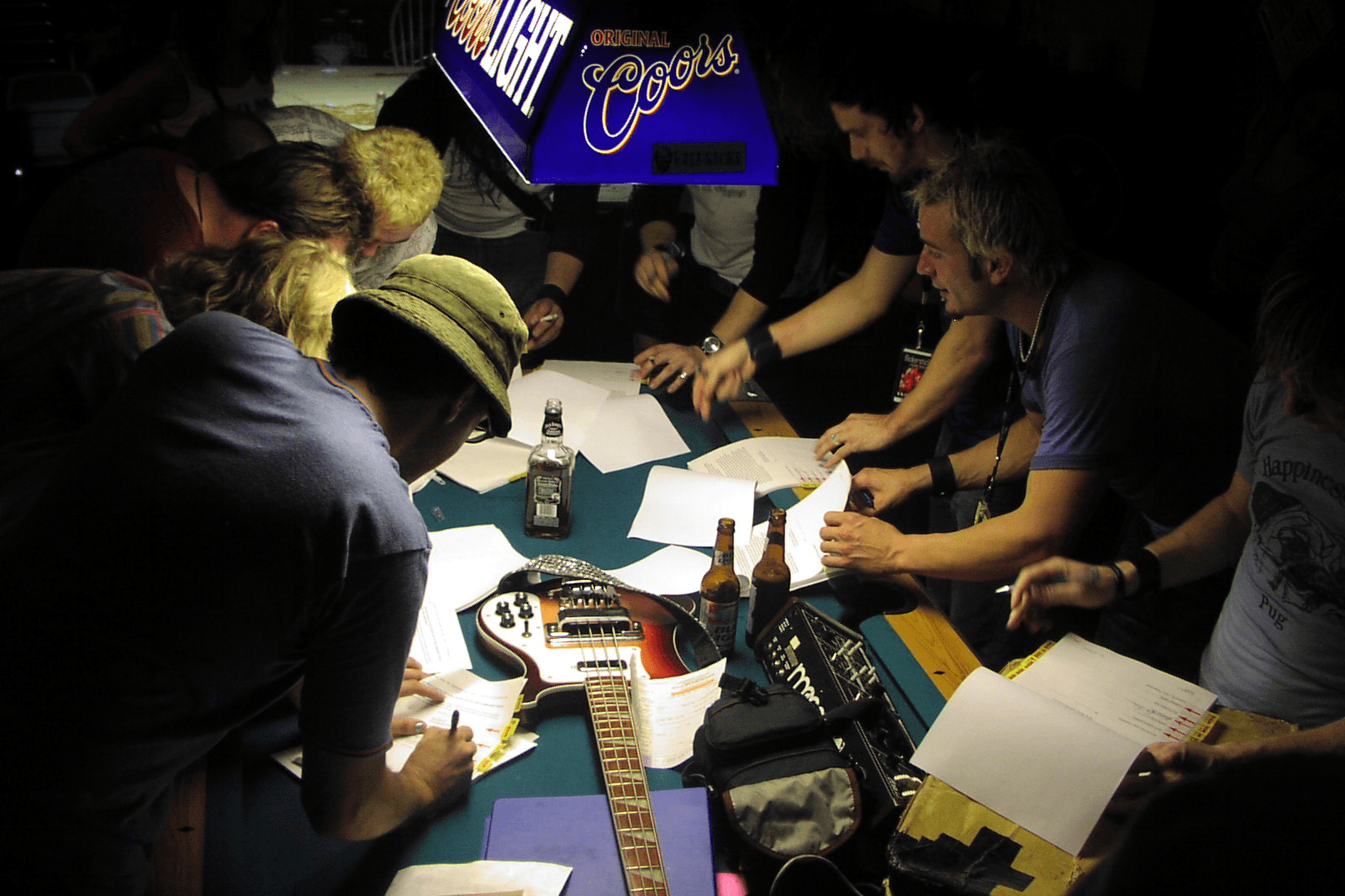
A tale of two contracts. July 2001, Birdy’s Bar and Grill, Indianapolis. Rubyhorse (left) inks a deal with Island Records on a pool table, while our tourmates Flickerstick sign with Epic Records the very same night. Two bands, two majors, one pool table.
That lasted until Simon came to Boston for a meeting.
He came to a rehearsal. Everything more or less in place. He was on his way out, coat on, and then stopped. Turned back, like something out of an episode of Columbo.
Just one more thing.
“Have you got anything else?”
We played him “Sparkle” a song Deck had written on the road. Something thrown at us backstage. We all felt there was something in it, though Deck wasn’t fully convinced.
Simon was.
“That’s a hit. You need to record that.”
So, reluctantly, we went back to Nashville to work with Jay Joyce again in the summer of 2001, right before 9/11. Not to start over, but to reshape what we had around this new centre. That’s where Rise really began to take form.
How Far Have You Come? had all the marks of a band with the shackles off, a kind of wild creative freedom. It felt like the grown-ups had left the room and we went a bit mad. That record leaned towards the artsy side. There were segues between songs, ambient pieces, a sense of flow. It was the sound of a band running amok in the best way.
The sessions for Rise were different. Sharper, more focused. The adults were back in the room. We were back on a major label now, our eyes on the prize. We held on to the core of what we’d created for How Far Have You Come? but we cut to the chase. Some of the connective tissue between songs was cut, and with it a bit of the more avant-garde instinct. That approach didn’t quite survive the shift into a major label world.
Even now, it’s hard to say exactly what changed. There were compromises, no doubt, we could feel that even at the time. But there was also a natural progression. Time had passed, and the new songs had settled into themselves. In the end, they stood on their own. We added “Bitter”, “Sparkle”, “Live Through This”, and a re-recorded “Into the Lavender”. We dropped “Touch and Go” and “She’s a Weapon”. It was a significant shift, the record beginning to take on a different shape. The songs won the day.
And we lived well with that.
From there, it was on to Miami.
By September 2001, after 9/11, the world had changed. South Beach was still light and colour, smoke and mirrors, and mirror balls!
In South Beach Studios, we were returning to the alchemist Tom Lord-Alge who we’d worked with before. This time we came in with a renewed sense of purpose, a bit more vitality, and something we truly believed in.
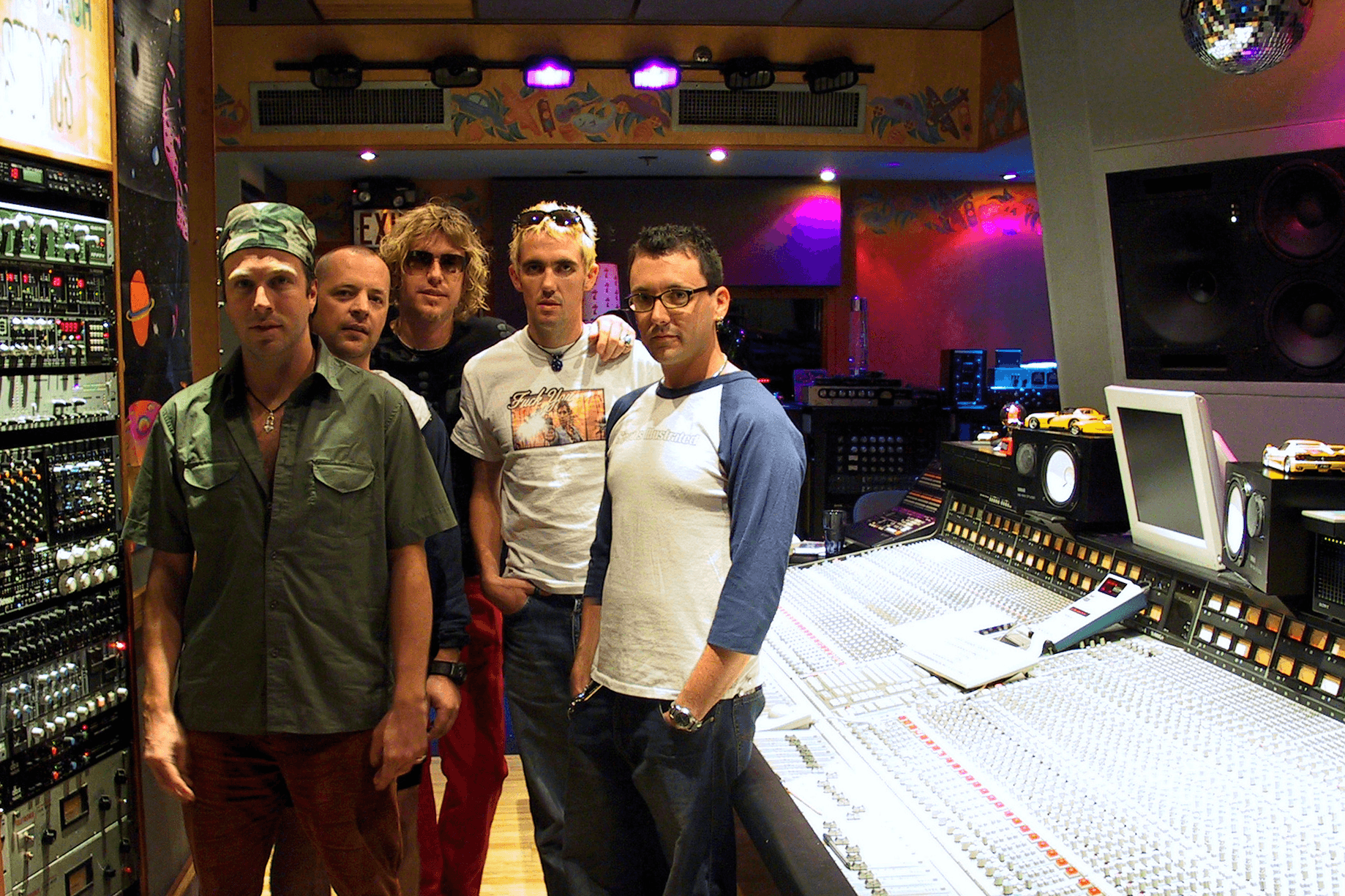
South Beach Studios, September 2001. Left to right: Joe Philpott (Guitar), Gordon Ashe (Drums), Dave Farrell (Vocals), Decky Lucey (Bass), Owen Fegan (Keyboards).
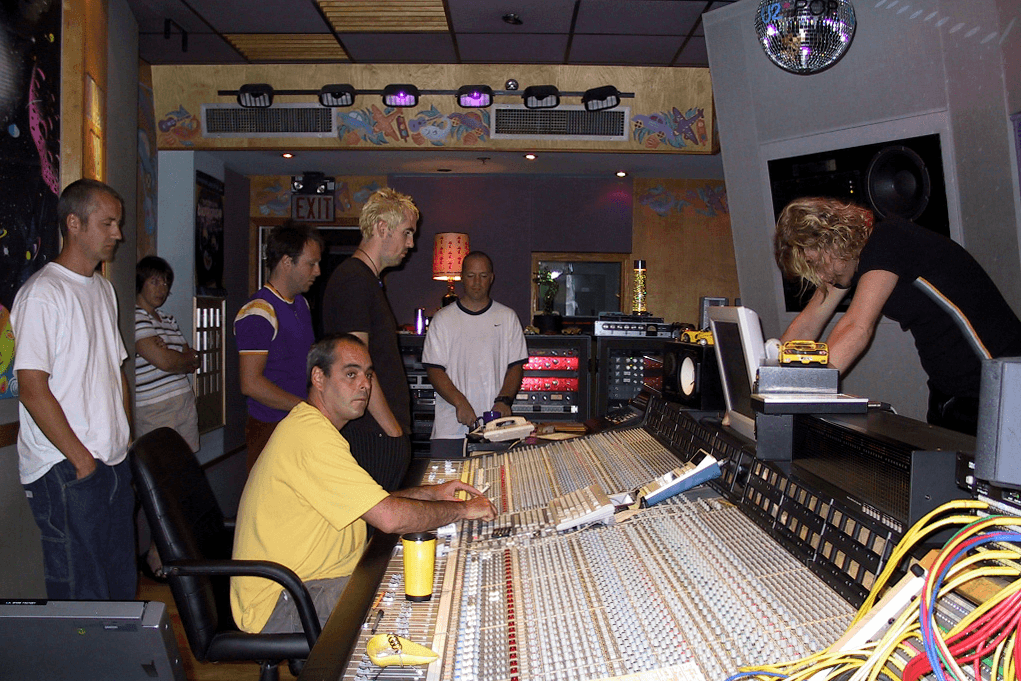
Left to right: Simon Collins (Island Records), Kathy Lobdell (Clear Channel Entertainment), Joe, Tom Lord-Alge (Mixing Engineer), Decky, Gordon, Dave
It was a joy to be back in that control room at the back of the Marlin Hotel, immersed in the process. Mixing, when you’ve made a good record, feels like a lap of honour. The race is run. You’re not chasing anymore, you’re revealing what’s already there.
And with someone like Tom at the helm, you could relax into it. You knew what came back through the speakers would carry weight, would have that thing he always talked about, a bit of “spank” to it.
“Sparkle”, more than anything, came alive in those sessions. You could feel it immediately. It wasn’t just another track. It had something. It became clear, sitting there listening back, that we might have a radio song on our hands.
We’d spend the day between the beach and the studio, sand still on our feet, flip-flopping back and forth before settling in to hear the mixes come through the speakers.
And there it was.
Weight, clarity, presence. Not a demo, not a maybe. A record. The kind of sound we’d been chasing for years.
You realise things in moments like that. Not all at once, but enough to know you’ve crossed a line.
Simon brought the song back to Island records head office in New York . He took it into the A&R meeting, one of those rooms where everything depends on a single decision, where something either goes through or it doesn’t.
In this case, it was Lyor Cohen at the top table, cigar gripped between veneered white Hollywood teeth, rings of smoke rising like signals, deciding your fate.
Apparently he stood up and applauded the song, setting off a chain reaction that said we had passed through the eye of the needle, that the record company were going to throw their significant weight behind it.
Game on.
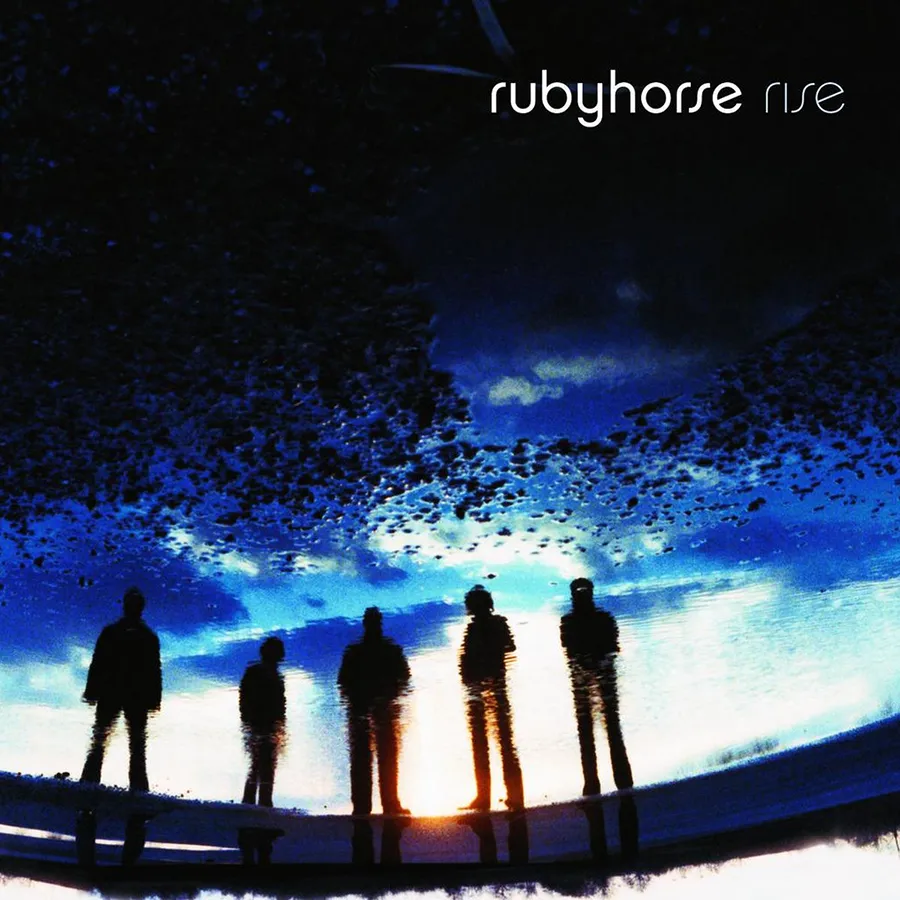
By the time Rise was released in 2002, we had already carried our songs a long way out of Cork and across America. Through vans and motel rooms, through soundchecks and long drives through the nights, through the slow, uncertain work of staying at it .
That’s what we carried.
In Ireland, there was a tradition. When people left, during the famine and long after, they carried very little with them. But they carried songs. And when they turned back to their families and asked what they might bring home, the answer was often the same.
Bring me back a song.
Those songs travelled. Across the Atlantic. Into Newfoundland, into the Appalachian Mountains, into places far from where they began. And sometimes, years later, they found their way home again.
What we were doing didn’t feel so different.
We carried our songs out into the world, and somewhere along the line, one of them began to travel further than the rest.
When “Sparkle” was released, it moved.
Not loudly at first, but with a kind of certainty. It slipped into heavy rotation, into cars, into radios, coast to coast. It found its way into people’s lives without asking permission, moving faster than any plan around it, leaving even the record company trying to catch up.
Driving through heat haze on Sunset Boulevard, windows down, you’d hear it drift in from another car. A chorus catching in the air, belonging to no one and everyone at the same time.
That was the moment.
Not when it was written, not when it was recorded, but when it left us.
Severance. Threshold. Return.
Only this time, it wasn’t a person crossing the ocean.
It was a song.
It carried us with it.
We moved across America in waves of gigs and miles, playing to rooms that got bigger as we went. There was momentum, real momentum. But there were gaps too. We never had the video that might have pushed it further. MTV and VH1 were still shaping the landscape then, and we stood just slightly outside that current. Timing, decisions, a few things missed by inches.
Still, the songs held.
We had been together since school. Through all the versions of ourselves, all the false starts, all the near misses. And now, suddenly, it felt like we had something solid in our hands.
Eleven songs. Eleven reasons to keep going.
Rise opened the door.
It brought us to Late Night with Conan O’Brien, to the Ed Sullivan Theater for The Late Show with David Letterman, and into the Billboard charts; it was the strange, surreal feeling of being inside something we had only ever watched from a distance.
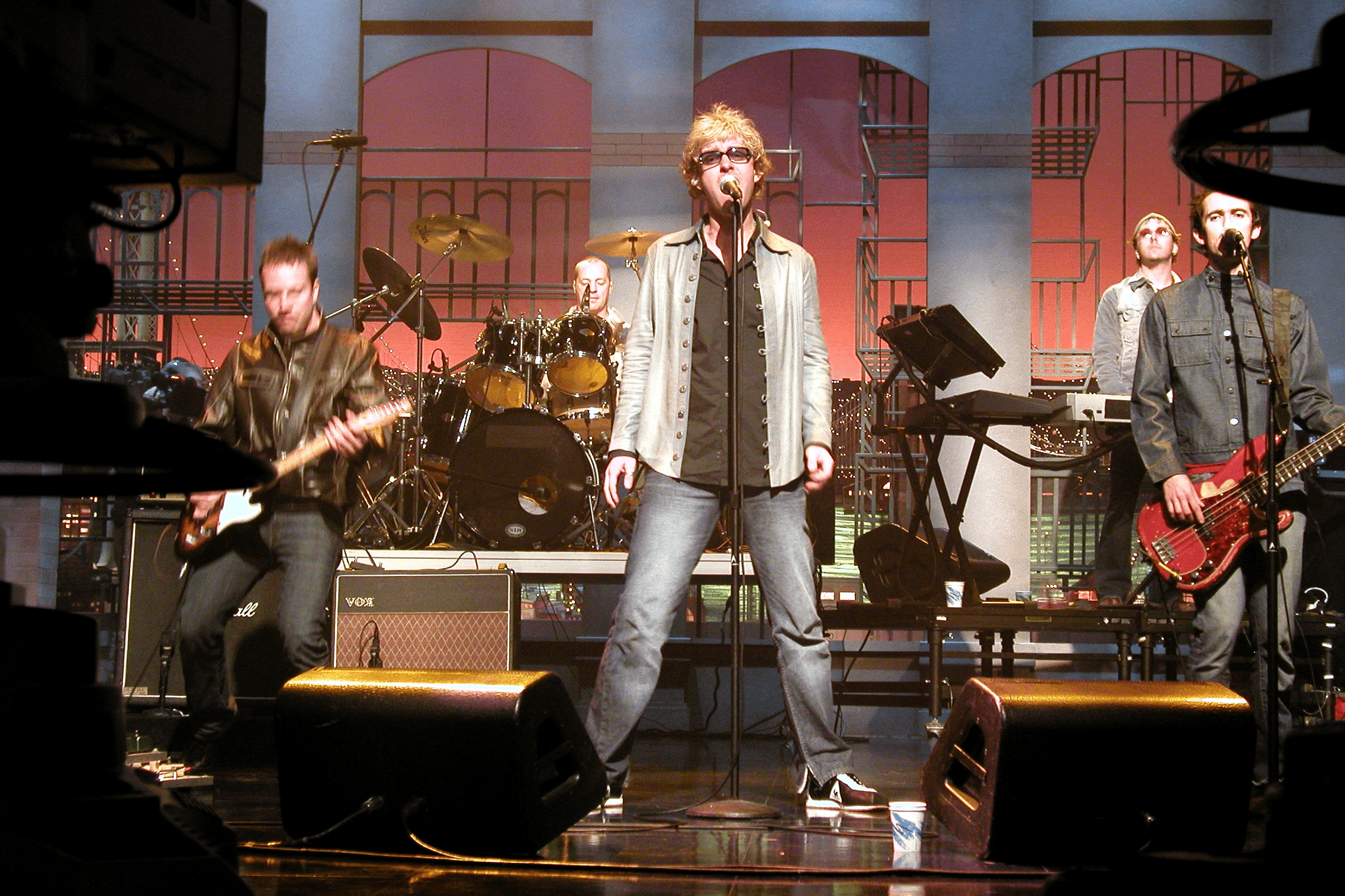
Late Night With David Letterman, July 2002.
A band from Cork, carrying a song across the heartland of America.
There were moments when it felt like too much to take in. A kind of fullness. Like being handed everything at once and not quite knowing where to look.
And maybe that’s what Rise really was.
Not just a record, but a crossing.
Everything that had gone before it. Every road, every wrong turn, every small act of persistence, meeting in one place.
Looking back, the journey wasn’t a straight line from one place to another. It bent and doubled back, lost its way, found it again. What we thought were setbacks were often the moments that shaped us most. What we thought we were chasing was rarely what we needed. The industry moved on, as it always does. The noise faded. But the songs remained, carrying everything with them, the hope, the confusion, the small victories, the hard losses.
In the end, that’s what we brought home. Not a career in the way we imagined it exactly, not a story that fits neatly into success or failure, but something more lasting. A body of work. A shared history. And the knowledge that, for a time, we followed it as far as it would take us, across oceans and cities, through doubt and belief, until we found ourselves again, not where we started, but somewhere closer to who we were meant to be.
And in the middle of all that madness, the chart success, the major studios, a collaboration with a Beatle, living and working in Los Angeles, Nashville, and Miami, and touring all over America, it felt like we had somehow been handed the full roast dinner with all the trimmings. We went everywhere. The only states we didn’t play were Hawaii and Alaska.
It was magical. It was improbable. It was Rise.
Joe Philpott
Cork, Ireland, April 2026.
All titles written and performed by Rubyhorse.
© 2002 Langer Dan Music (BMI)
Produced by Jay Joyce
Recorded by Jay Joyce and Giles Reaves at Tragedy/Tragedy, New Reflections, and East Iris Studios, Nashville TN
Assisted by Josh Bracket, Kevin Szymansky, Mark Rolsten, and Patrick Hines
Additional musicians:
Jay Joyce: guitar, keyboards, and background vocals
Gary Tussing: cello on "Any Day Now" and "Punchdrunk"
George Harrison: slide guitar on "Punchdrunk"
Mixed by Tom Lord-Alge at South Beach Studios, Miami FL except "Punchdrunk", "Teenage Distraction" mixed by Jay Joyce and Giles Reaves at East Iris Studios, Nashville, TN; "The First of the Year" produced by Rubyhorse, recorded by Mudrock at New Alliance Studios, Boston MA, and mixed by Owen Fegan at EIO Studio
Mastered by George Marino at Sterling Sound, NYC