


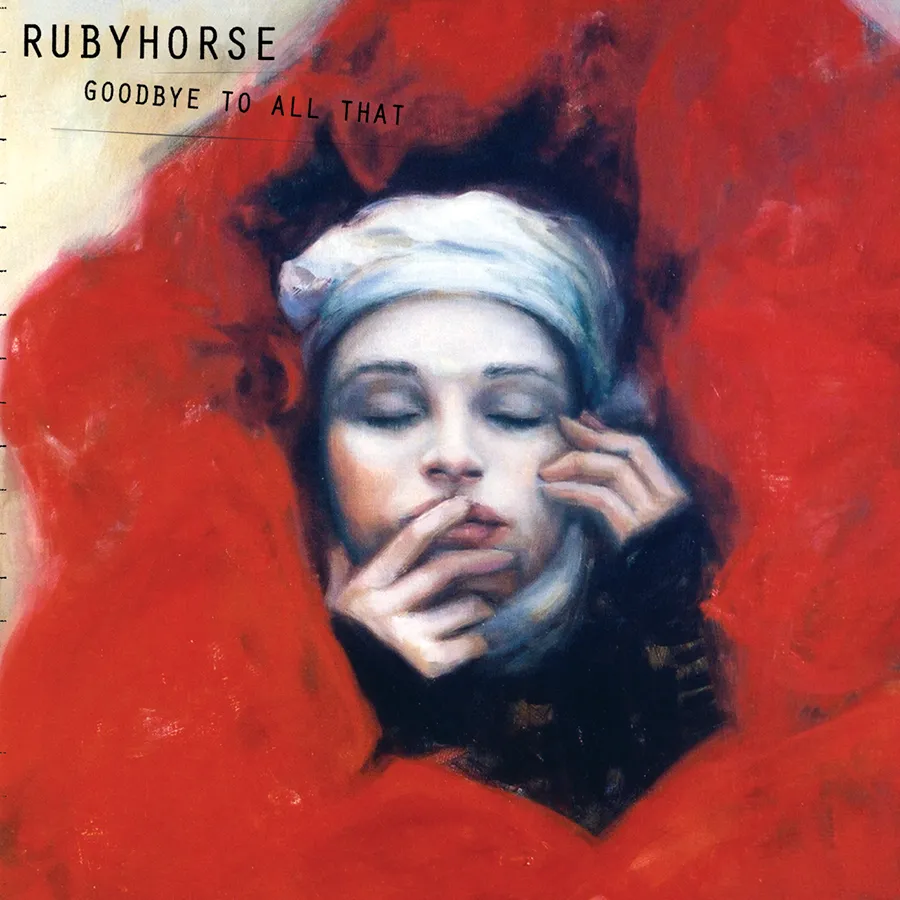


Goodbye to All That
As told by by Joe Philpott
We probably felt it in our bones. This may have been the swan song and, as it turned out, it was.
We had been through the wringer of an industry in free fall. A bidding war. Two major-label record deals. All the trimmings of a rock-and-roll odyssey through our twenties. By this point, we were definitely a bit punch-drunk.
The value and outcome of all that effort didn’t match whatever ambition we might once have had. The jobbing, town-to-town, U-Haul trailer, Holiday Inn, wherever-I-lay-my-hat way of living wasn’t really suiting anybody in hindsight. The shine had come off that one. The troubadour door had shut. Eyes were turning towards different prizes, but there was no space to catch our breath or gain any perspective.
“Too much perspective”, as the Spinal Tap boys might have said.
Owen had left the band, and at this point things were starting to sound like a Bryan Adams song.

Rubyhorse, now a 4-piece pictured in Nashville in January 2004
There were probably elements of surrender already within us as we scraped together the demos in Scabby Road, Decky’s home studio in Boston, for what would become the final album, Goodbye to All That. We began drawing from a different kind of well. A darker, deeper one.
If the record label had any notions of "Sparkle" Parts Two, Three, Four, and Five coming its way, those notions were well and truly abandoned. In their place came darker, more introspective songs.
Even the titles told the story: "Some Dream", "Fell on Bad Days", "Sorrow", "Long Time Coming", "A Place in the Sun", "Can You Feel", "Never Grow Old", "Underneath", "Warning Bells", "Long Weekend" and, finally, "Company Man".
Dreams, sorrow, bad days, warning bells, and company men. The clue wasn’t just in the name of the album. It was written all over the record.
Up to this point, we had been a five-legged table, chiselling away at the music together and arranging things live in rehearsals, live rooms, and touring settings. By the time a song was committed to tape, it was already well worn. It had its own history. It had been lived in.
Now Decky had taken the songwriting helm.
Daniel Lanois has said that one of the best things you can do in a production environment is to see a single idea all the way through. That became the approach. Owen had left. I had abandoned any notion of contributing to Rubyhorse from a songwriting point of view and began concentrating instead on what I could bring to the sounds Decky was creating.
The songs arrived more fully formed now, with arrangements already pointing towards what we would ultimately play on the record. The process had changed because the band had changed.
Having been dropped by Island Records, we were a completely different version of what we had once been. Yet through the generosity of one of those angels who occasionally appeared along the Rubyhorse road, we managed to scrape together enough money to keep moving.
Jord Poster, a prominent Boston businessman and philanthropist, first came to see us at the Paradise. We hit it off straight away. He saw something in us, and what began that night developed into a relationship built on his advice, belief, and support. When we found ourselves without major-label funding, Jord provided the initial investment that enabled us to begin recording. He had believed in and helped the band for quite some time, and when we found ourselves in a jam, Jord helped get us out of it. He has since passed away, but without his generosity, there is every chance that this final chapter of Rubyhorse would never have been written.
That relationship had already brought us to Bali, where, on 14 June 2003, we performed at the inaugural World Peace Music Awards in Denpasar. The event took place eight months after the terrorist bombings of October 2002 had blown apart the peace of the island and devastated its tourist economy. The idea was to draw international attention back to Bali as a safe place to visit.
Around 15,000 people attended. The bill included INXS, by then without Michael Hutchence, Gloria Gaynor, Maxi Priest, Kinky, Aswad, Slank, Emma Shapplin and a host of international acts. INXS closed the concert, while Gloria Gaynor stood onstage and sang "I Will Survive". It was one of those extraordinary places Rubyhorse could still take us, even as the centre of the band was beginning to give way.
Truth be told, our heads were scrambled.
We were completely and utterly cut adrift from the mainstream, major-label industry circus we had been run through. Our heartbeat was operating a little slower.
Owen left in August 2003. He had contributed significantly to the early demos and recordings and would remain on the finished album, playing keyboards and sequencing. In that sense, it was still the five of us making music together. But the record would be completed, presented and toured by a four-piece.
It became clear that the album we were about to make would be very different and, arguably, our strongest artistic statement.
We were a long way from the enormous recording budgets once afforded to us by major labels, but we managed to pull together enough money to return to Jay Joyce in Nashville. Time and money were tight. The Nashville sessions would take place over two weeks. The plan was simple: record one song a day.


Recording at Tragedy/Tragedy in Nashville
The record was built between Scabby Road in Boston and Jay’s Tragedy/Tragedy studio in Nashville. Jay Joyce and Rubyhorse produced it. Jay, Jason Hall, and Decky engineered it, and Jim DeMain mastered it at Yes Master in Nashville.
We also had Tim Palmer mixing "Long Time Coming" and "Underneath". Tim had mixed Pearl Jam’s Ten and worked extensively on U2’s All That You Can’t Leave Behind, the album that contained "Beautiful Day". Even at this reduced and battered stage of the journey, we were still managing to bring people of that calibre into the Rubyhorse world.
Packing the Ford and heading towards Nashville should have felt familiar. But beneath it ran an unmistakable current of sadness. The whole thing was beginning to tear apart at the seams. Not everybody was happy in their skin anymore, or at least not in their Rubyhorse skin.
It felt like one more roll of the dice.
It became one of the most beautiful, creative, and immersive musical experiences we ever had. With nothing left to lose and our backs against the wall, something opened up. Sometimes, under those conditions, great things happen. Sometimes great art happens.
In this case, we made a musical statement that still feels timeless to me. Unaffected, unbridled and uncompromisingly direct.
A statement in itself.


Recording at Tragedy/Tragedy in Nashville
The album carried melancholy tinged with acceptance and surrender, but there was defiance in it too, along with occasional modicums of joy. The studio was familiar, and the structure of the days replicated the way we had learned to work with Jay and Jason. The power of the band remained undeniable, while the songwriting had reached a place it had never occupied before.
When the reviews appeared, other people seemed to hear the same thing. The record was described as dark, introspective, and coloured by disappointment. Another review heard something melodious, crestfallen, and entirely honest, full of memories that were both downhearted and yearning. It was called slow, swaying, and bittersweet, richly layered and textured, with dreamy vocals and a country heart.
One reviewer described the songs as tuneful and lushly atmospheric, with acoustic guitars pushing against distant electronic sounds, swelling keyboards, and layered backing vocals. The descriptions were remarkably close to what had actually gone into making it: exhaustion, melancholy, honesty, and surrender.
"Fell on Bad Days" was an absolute cracker.
The story that came back to us was that Denis Leary heard it while driving through Boston and that it stopped him in his tracks. He made it a personal favourite and found a home for it in Rescue Me, applying it to his own character, Tommy Gavin.
The closing sequence of "Sanctuary" — the Season 1 finale of Rescue Me, featuring "Fell On Bad Days"
On 13 October 2004, less than four months after the album was released, "Fell on Bad Days" played over the final sequence of "Sanctuary", the season-one finale of Rescue Me. It would later appear on the programme’s official soundtrack and be used again in the season-two finale.
The placement could hardly have been more apt. Rescue Me was a show about New York firefighters living with grief, trauma, alcoholism, loyalty and the shadow of 9/11. "Fell on Bad Days" sounded as if it had been written for people attempting to remain standing while everything around them came apart.
It was another one of those strange Rubyhorse contradictions. Just as the spirit of the band was dying, one of our strongest songs was finding its way into millions of homes.
Goodbye to All That was released in America by the Atlanta-based Brash Music label on 22 June 2004. Eleven songs and forty-four minutes of music. Tours followed. We played Iota in Washington at the end of July and returned to the Paradise in Boston on 21 October, a show that was recorded and released through the Instant Live series.
On paper, things were still happening. The album had been well received. The songs were finding their way into television. We were touring America and Ireland. There were still reasons to continue.
But the spirit was no longer intact.
Nashville, where fireflies and dreams had once taken flight, was now where we came to lay it all down. We played as though it might be the last time we would ever play together.
In many ways, it was.
This was the final time Rubyhorse would record with Jay, and it would be the last album we would release. We continued into 2005, but eventually we had to accept what the record had been telling us all along.
It was time to say goodbye to all that.
Joe Philpott
Cork, Ireland, August 2026.
Produced by Jay Joyce and Rubyhorse
Recorded at Tragedy/Tragedy, Nashville TN and Scabby Road, Boston MA
Engineered by Jay Joyce, Jason Hall, and Declan Lucey
Mixed by Jay Joyce
Mastered by Jim Demain at Yes Master, Nashville, TN
Dave Farrell: vocals, percussion, piano
Declan Lucey: guitars, bass, keyboards, programming, vocals
Joe Philpott: guitars, bass, mute trumpet
Owen Fegan: keyboards, sequencing
Gordon Ashe: drums, percussion, fucked-up banjo
Additional Musicians:
Jay Joyce: guitars, keyboards, programming, vocals
Owen Fegan: piano on "Warning Bells" and "Long Weekend"
All songs written by D. Lucey
Music written and performed by Rubyhorse
©2003 Langer Dan Music (BMI), Rubyhorse